
MS67 Coin Grade: What to Check Before You Buy the Holder
MS67 coin grade looks impressive on a label. It should. It sits high in Mint State and usually signals a strong coin. Still, the number alone does not make the purchase smart. Before paying the premium, the buyer should check the series, the surfaces, the luster, the strike, and the market gap around the grade.
What MS67 Really Means
MS67 is a premium Mint State grade. The coin should look clean, attractive, and far above average. It is not perfect. Small marks can still be present. Minor weaknesses can still exist. The key is overall quality.
This is where many buyers go wrong. They read MS67 as “almost flawless” in every series. That is not how the market works. In one series, MS67 may be available with patience. In another, it may already be a serious condition rarity.
| Grade Level | First Impression | Market Reality |
| MS66 | Strong coin | Often available |
| MS67 | Premium coin | Sometimes common, sometimes important |
| MS68 | Elite coin | Often much harder |
That table is the first checkpoint. The same number does not carry the same weight on every coin.
Buy the Coin, Not Just the Holder
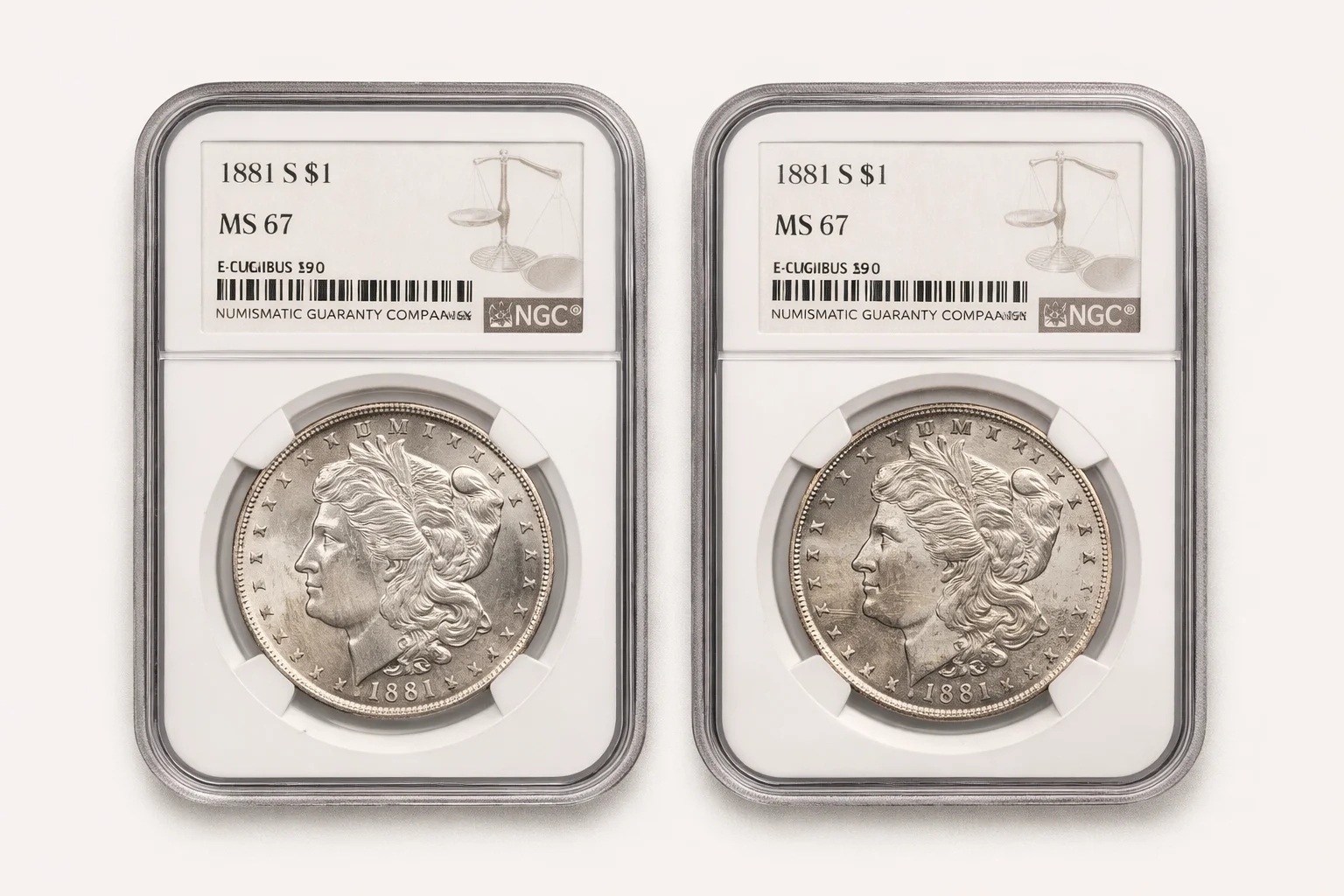
This is the main rule of the article. The holder gives a grade. It does not tell you whether the coin is strong for the grade, weak for the grade, or priced well. It does not tell you whether another example in the same grade looks much better.
Many collectors still buy in the wrong order. They see the slab. They see the number. They see the price. Then they finally look at the coin. The better order is the opposite.
Check the coin first. Then ask what the holder adds.
| The Holder Tells You | The Holder Does Not Tell You |
| Assigned grade | Whether the coin is strong for the grade |
| Attribution | Whether the eye appeal fits the price |
| Certification status | Whether the premium makes sense |
| Market category | Whether better examples are easy to find |
This matters most in high Mint State. Once the coin reaches a strong level, small differences begin to cost real money.
Series Context Comes First
A premium grade must be read inside the series. MS67 on a modern bullion issue is not the same challenge as MS67 on a Morgan dollar, a Washington quarter, or a copper cent. Strike quality, mark tolerance, luster style, and survival rates all change from one series to another.
That is why the first real question is not “Is MS67 high?” The first real question is “How hard is MS67 for this coin?”
A buyer should know:
- How often the series reach this level
- Whether MS67 is normal or hard
- Where the next major price jump begins
- Whether the issue is heavily submitted
Without that context, the holder can look more impressive than it really is.
Check the Surfaces Before Anything Else
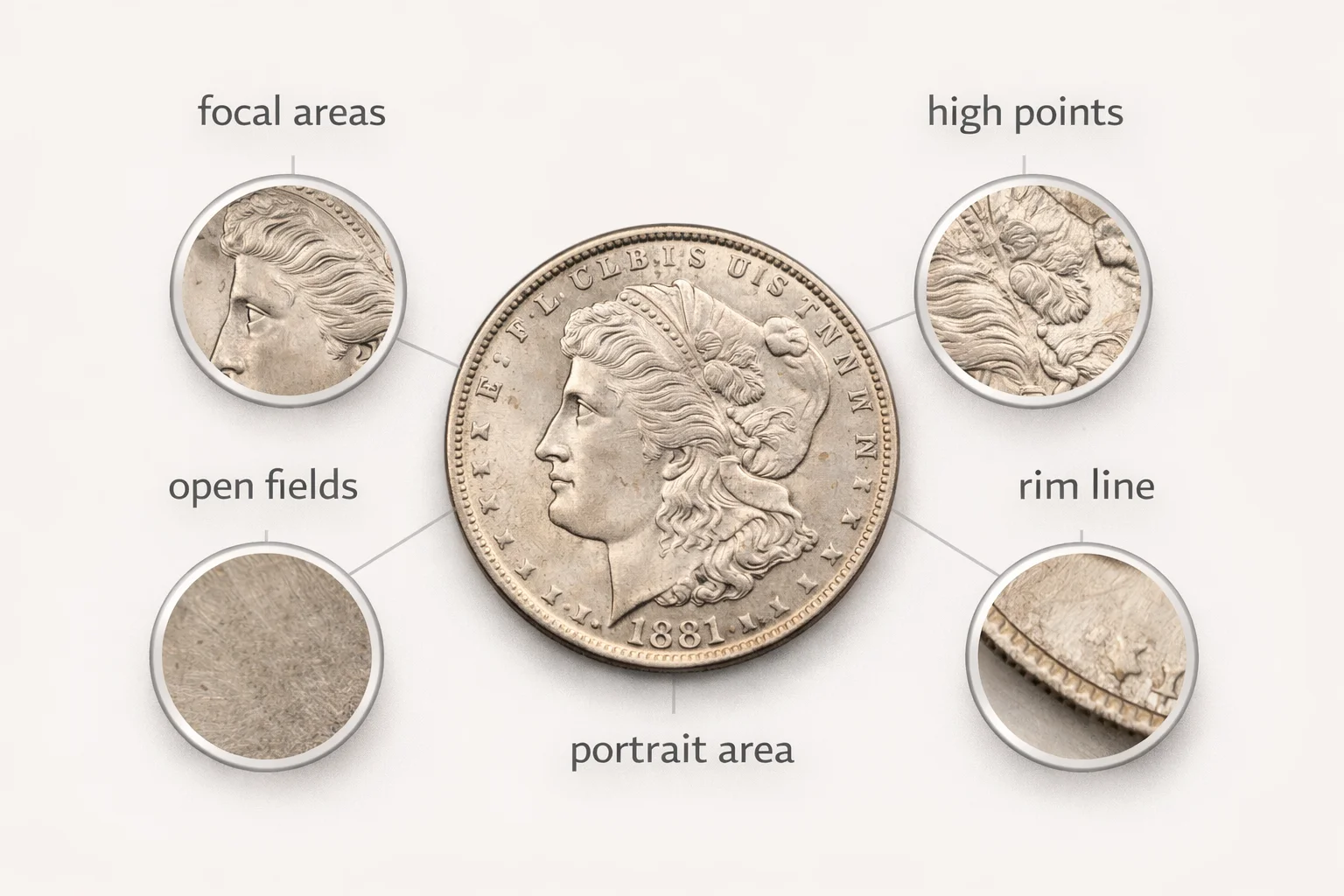
Surfaces usually decide the first reaction. If the fields look busy, the focal areas show too many hits, or the portrait has distracting contact marks, the coin may feel weak even with a strong label. This is why experienced buyers study the coin before reading the cert line too closely.
The first places to inspect are simple:
- Focal areas
- Open fields
- High points
- Rim line
- Areas near the main portrait or device
On portrait coins, the cheek or jaw often matters. On coins with broad fields, chatter stands out fast. On frosty pieces, a single bright hit can break the visual flow. None of this means the coin is overgraded. It means the coin may be ordinary for the grade rather than impressive for it.
Two slabbed MS67 coins can differ more than many beginners expect.
Luster and Eye Appeal Carry Real Weight
A high-grade coin should not look dead. It should have life. The exact form changes by metal and by series, but the principle stays the same. Luster is not decoration. It is part of the grade experience.
A silver coin may show rolling cartwheel luster. A nickel coin may show a more compact glow. Copper needs fresh, original color and healthy surface texture. When the luster looks weak, flat, or broken, the coin loses part of its premium feel.
| Strong for the Grade | Weak for the Grade |
| Fresh luster | Flat luster |
| Clean focal areas | Distracting marks |
| Balanced look | Uneven look |
| Good visual flow | Tired appearance |
Eye appeal matters because the buyer is already paying for a better coin. A slab with a strong number and weak visual presence often becomes a regret purchase.
Strike Quality Still Matters
Strike is not the same thing as grade. A sharply struck coin can still have too many marks. A softly struck coin can still grade high if the surfaces are clean and the issue normally comes that way. Still, the strike should be checked before buying the holder.
This is especially true in series known for soft central detail, flat hair, weak breast feathers, or incomplete reverse elements. The buyer should know the normal strike pattern of the issue. That helps separate a common weakness from a disappointing specimen.
A useful way to read this is simple:
- Strong strike helps confidence
- Normal strike may be acceptable
- Weak strike plus weak surfaces is a warning sign
If the coin already looks average in strike and average in surfaces, the slab alone has to work too hard.
Read the Market Around the Grade
A slabbed coin is a market item, not only a technical object. That means the buyer should check the price relationship around the grade before paying up. The critical question is not just what MS67 sells for. The real question is what happens between MS66, MS67, and MS68.
Sometimes the step from MS66 to MS67 is modest. Sometimes it is large. In some series, MS67 is the practical target because MS68 becomes too expensive. In others, MS67 is only a middle stop with a lot of supply.
This is one place where a coin appraisal app can help. Not as a final authority. Not as a grading tool. As a quick value frame. If the asking price sits far above the normal band, the buyer knows to slow down and compare more carefully.
That step does not replace judgment. It helps stop blind premium buying.
Population Numbers Need Context
Population reports look simple. They are not. A low count can mean real scarcity. It can also mean that few people bothered to submit the coin. A high count can mean easy availability. It can also reflect heavy registry demand and years of repeat submissions.
The useful questions are these:
- How many are graded MS67
- How many are finer
- Is the supply growing
- Does the series have active demand
A coin with a large MS67 population and many finer examples should be priced more carefully. A coin with a modest count and a steep jump to the next grade may deserve more respect.
Population alone is not enough. Population plus demand tells the real story.
Check the Price Jump Before Paying the Premium
This part should be practical. Before buying the holder, compare the spread around it.
| Question | Why It Matters |
| Is MS67 much rarer than MS66 | Helps explain the premium |
| Is MS68 far above MS67 | Shows whether MS67 is the realistic target |
| Are many coins available in MS67 | Helps measure market depth |
| Does this coin look strong for the grade | Protects against overpaying |
A smart buy usually sits where the grade premium and the coin quality match. A weak buy appears when the number is expensive, but the coin does not look special.
This is why some MS67 coins feel worth the jump, and others do not. The label is the same. The market logic is not.
Photos Can Sell the Number Better Than the Coin
Online buying adds another problem. Photos can hide marks. They can flatten luster. They can make toning look cleaner than it is. Some listings show the slab well and the coin poorly. That is not the same thing.
Before paying strong money for a slabbed coin, check whether the images show:
- Tilted light
- Both focal sides
- Clean close detail
- True luster movement
- Any distracting marks
A flat photo can make an average coin look smooth. A bright photo can hide chatter. A dark photo can hide hairlines or dullness. One image is rarely enough for a premium-grade purchase.
What to Decide?
When an MS67 Coin Is a Good Buy
A good buy usually has a few things working together. The coin looks right for the grade. The premium over the next grade down is understandable. The next grade up is not easy. The series supports steady demand. The surfaces and luster feel honest and strong.
Good reasons to buy the holder:
- The coin looks strong for MS67
- The premium over MS66 makes sense
- The next grade is much harder
- The issue has real demand
- The eye appeal is above average
This is where the buyer stops chasing numbers and starts buying quality.
When the Holder Should Not Convince You
Some slabbed coins ask too much without giving enough back. The number looks strong. The coin looks tired. That is the danger zone.
Reasons to pause:
- Weak surfaces
- Dull appearance
- Distracting marks
- Easy grade for the series
- Thin value logic
- Premium price without premium look
A holder should support the coin. It should not have to carry the whole sale.
Practical Screening Before You Commit
Late in the process, simple tools still help. Use the free coin app for quick sorting, rough value comparison, and fast checks across similar certified pieces. This is not about replacing grading. It is about saving time before the deeper review.
Coin ID Scanner can help with value-oriented screening and smart filters. That makes it easier to narrow the right date, mint, and type, then compare the slabbed coin against the broader field before paying a premium. It is a screening tool, not the final word.
That final word still comes from the coin itself.
Final Checklist Before You Buy the Holder
Before buying, run through the same short checklist every time:
- Know the series
- Read the surfaces
- Judge the luster
- Check the strike
- Compare the price jump
- Read the population carefully
- Do not trust one photo
- Buy the coin, not only the number
That is the best way to read MS67 correctly. The grade matters. The holder matters. The coin matters more.